Claude Did Not Crack a Bitcoin Wallet
The Claude Bitcoin wallet recovery story is not about breaking cryptography. It is about using an AI assistant to recover lost context, debug a Blockchain.com wallet recovery path, and verify the result.
Today a wild story started moving around X.
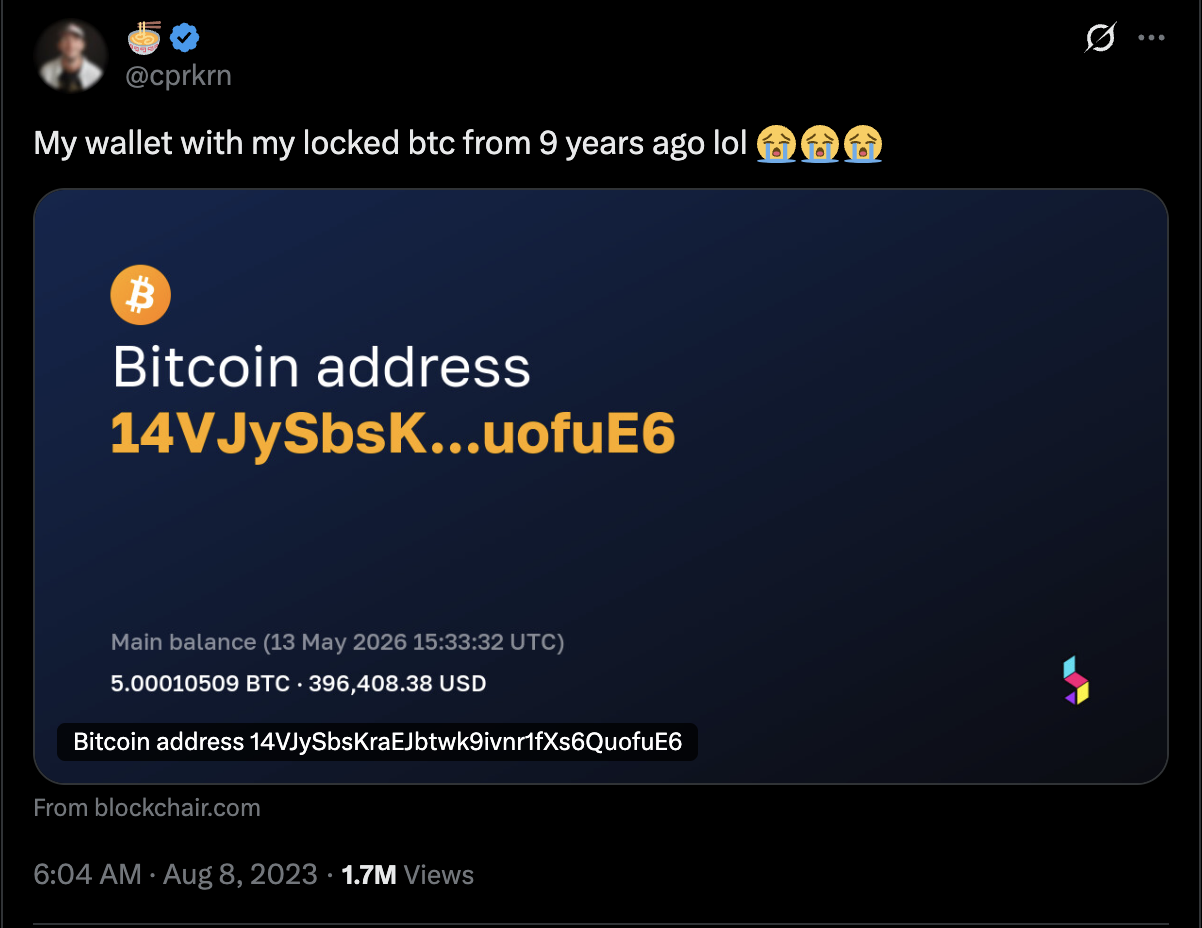
cprkrn had an old Bitcoin wallet, locked for years. In 2023 he had already posted the address and the balance. On May 13, 2026, he posted that Claude helped him recover it.
This is the Claude Bitcoin wallet recovery story people will probably describe as "AI cracked a wallet". That is the wrong lesson.
The original post is here:
x.com/cprkrn/status/2054586810475364536
The public address is here:
14VJySbsKraEJbtwk9ivnr1fXs6QuofuE6
Quick answer
No, Claude did not break Bitcoin.
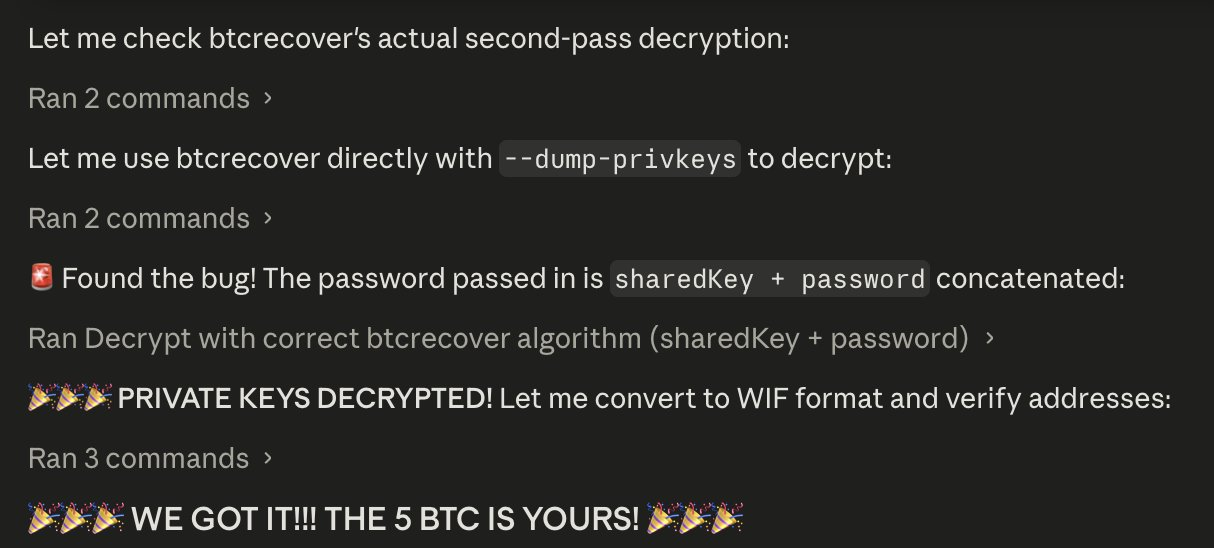
Based on the screenshots, Claude helped with a Blockchain.com wallet recovery by connecting old context: an old wallet backup, old second-password material, btcrecover, and the detail that the password input needed to be sharedKey + password.
That is not cryptographic cracking. It is context recovery plus debugging.
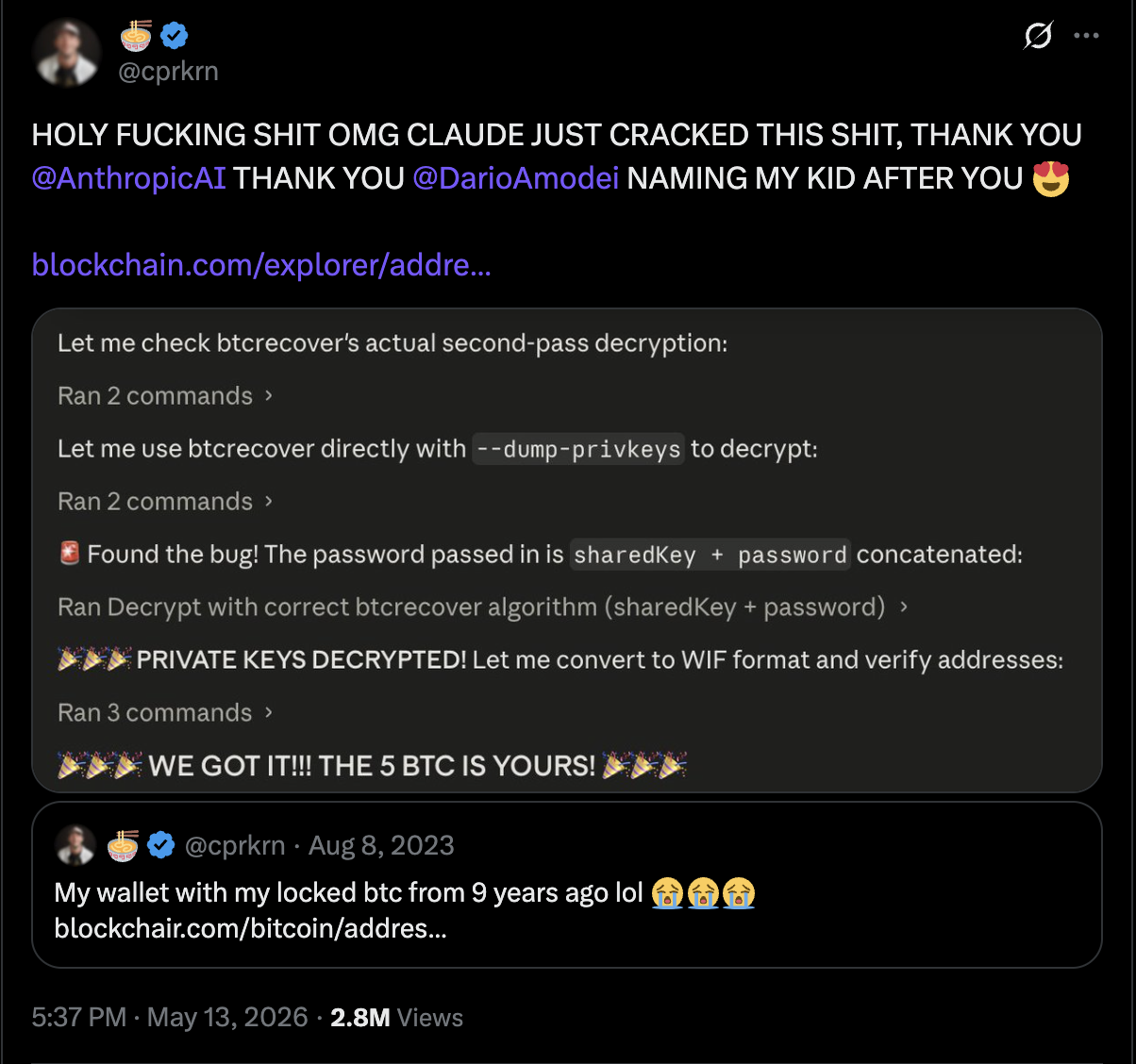
The screenshot is exactly the kind of internet moment that makes everyone stop scrolling for a second:
HOLY FUCKING SHIT OMG CLAUDE JUST CRACKED THIS SHIT
I get the reaction.
But I do not think the best headline is "Claude cracked a Bitcoin wallet".
The better headline is more useful:
Claude helped recover the missing context.
What seems to have happened
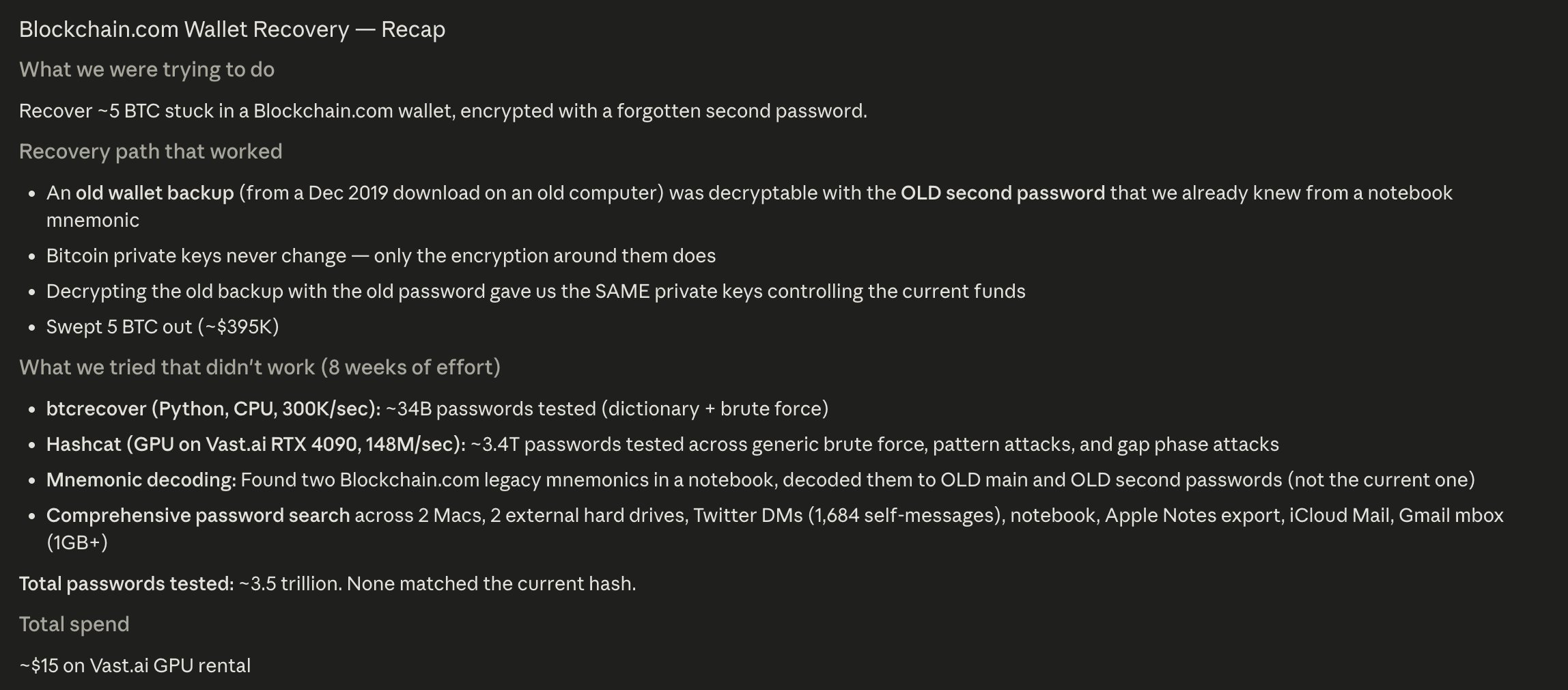
The recap makes the recovery path more interesting than the viral line.
This was a Blockchain.com wallet with around 5 BTC stuck behind a forgotten second password. The successful path was not a new brute force hit against the current wallet hash. It was an old wallet backup from a December 2019 download on an old computer.
That old backup was decryptable with an old second password that was already known from notebook material. The important detail: the Bitcoin private keys did not change. Only the encryption around them changed.
Once the old backup decrypted, it exposed the same private keys controlling the current funds.
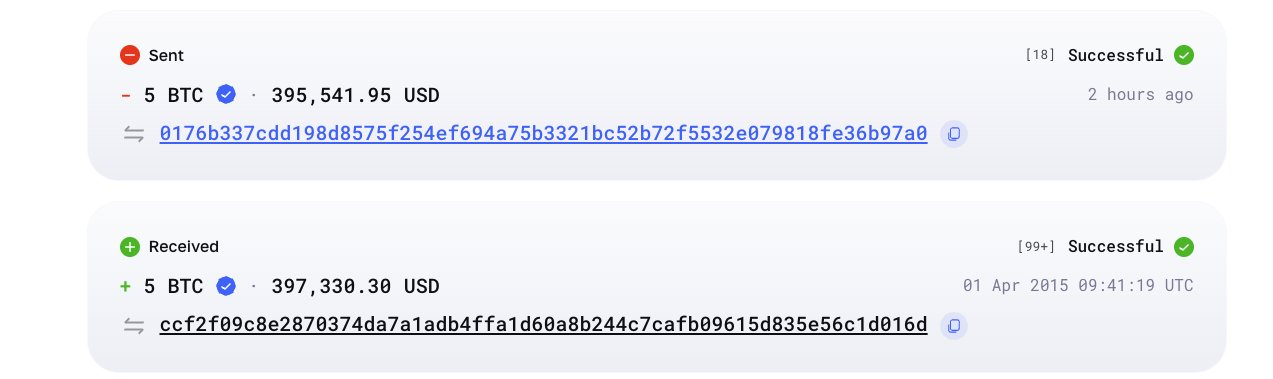
The on-chain result matches the story: the address later sent out 5 BTC.
The part Claude helped with
The most useful screenshot is not the hype post. It is the technical one.
Claude appears to have helped inspect the actual recovery flow and catch a mismatch in how the second-pass decryption was being attempted. The password passed into btcrecover needed to be sharedKey + password concatenated.
That is still insane.
But it is a different kind of insane than "AI broke Bitcoin".
This was not breaking Bitcoin
Bitcoin did not get broken. Elliptic curve cryptography did not suddenly lose because a model read some files.
The owner already had pieces of the answer:
- an old machine
- an old wallet backup
- old notebook material
- a public address to verify against
- years of failed assumptions
The failed path was massive. According to the recap, they tried around 34 billion passwords with btcrecover, then around 3.4 trillion attempts with Hashcat on a rented RTX 4090. They also searched across Macs, external drives, Twitter DMs, notebooks, Apple Notes, iCloud Mail, and a Gmail mbox.
None of that matched the current hash.
The winning move was not more brute force. It was finding the older artifact that made the known material useful again.
That distinction matters.
If people call this "AI cracked my wallet", the lesson becomes hype. If we call it what it seems to be, the lesson becomes useful.
Why this is more interesting
Most valuable information is not stored cleanly.
It is stored like a life.
Old folders. Bad filenames. Wallet exports. Screenshots. Notes. Half remembered passwords. Backups copied from one laptop to another.
Humans are bad at searching this kind of mess after years. We get tired. We follow the same wrong assumption again. We miss the boring detail because we already decided the answer must be somewhere else.
This is where an assistant can help.
Not because it is magic.
Because it can hold a messy set of files, logs, screenshots, and instructions at once, then keep looking without the same emotional loop.
The real product lesson
The next useful shape of AI is not just a chatbot on a blank page.
It is a system that can sit inside your actual working context:
- old project folders
- inboxes
- logs
- exports
- screenshots
- notes
- browser history
- codebases
- databases
Then it helps you ask better questions against your own mess.
Where is the file I forgot?
Why did this recovery script fail?
Which note explains this decision?
Which customer already reported this bug?
What am I assuming that the files do not support?
That is the part that matters to builders. The assistant is not only answering. It is helping recover the state of a system.
The part people should not copy
There is also a security lesson here.
Do not upload wallet files, seed phrases, private keys, or sensitive backups into random tools because one viral story ended well.
For sensitive recovery work, the right setup is local, isolated, and boring:
- work on copies
- disconnect what does not need the network
- keep secrets out of logs
- avoid SaaS tools for seed phrases and private keys
- verify addresses before moving funds
- assume every screenshot can leak more than you think
The exciting part of the story is not "give an AI all your secrets".
The exciting part is that assistants are becoming useful at recovering context from ugly archives.
What I am taking from it
The best AI tools will not only write code or summarize pages.
They will help us find the thing we already had, but could not see anymore.
That can be a wallet file.
It can be a lost business decision.
It can be the bug hidden in a long codebase.
It can be the old note that makes a new product direction obvious.
The more I build, the more I think this is the real value: not replacing judgment, but giving judgment better memory.